P. Desikan

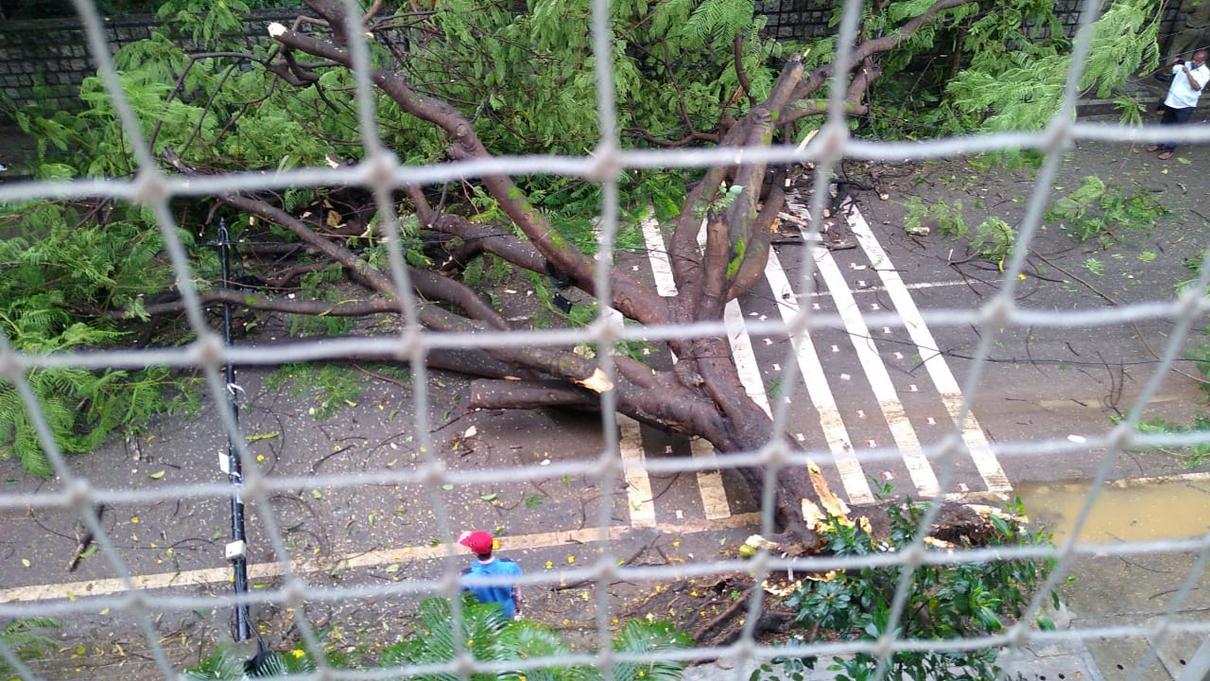
This happened on October 3, 2021, when I had turned eighty-five. This gul mohur tree just outside our apartment building that appeared alive and well up to about 5-15 pm that day suddenly got uprooted by the fierce velocity of the winds, closely following the showers that had ceased some half an hour earlier. Fortunately no man, animal or vehicle got under it. An autorickshaw just escaped being mauled. You will notice the electric post that had been brought down by the tree in the picture above that I snapped on my phone.
I had taken this snap from my balcony on the second floor well before help came to clear the tree. I was then residing in a building on 8th Main road, Malleswaram, Bangalore. Immediately to our North we had a vacant plot where foundation work for a new building had been started. Next to that the 15th Cross road goes East to West, through the busy Chitrapur Math traffic circle, which we could see from our balcony, though not in this picture.
West of the circle is the compound housing Panchavati, the former residence of India’s famous Nobel Laureate Scientist, Sir C V Raman. Its main gate is on 15th Cross road facing North. His name, C V Raman and the name for his residence, Panchavati, chosen by his wife Lady Lokasundari Raman can be seen on the stonework pillars on the two sides of the front gate. The plot is itself lush with trees, most of which reportedly were planted by the great man himself, in the course of his stay here between 1940 and 1970.
On October 4, when the city workers had removed the fallen tree, I looked out from my balcony into Panchavati and was surprised to notice what appeared to be a circular stage partially surrounded by a cement gallery in three rows, which could serve as sitting space for a few hundred spectators for whatever had to be performed on the stage. This amphitheatre arrangement among the trees appeared to be a work in progress and both excited my curiosity and increased my desire to try and visit the place. My wife and I had seen the stone nameboards at the gate during our earlier walks down the 15th Cross Road. Since the trees and the amphitheatre seemed to welcome us inside, we checked with the security guard and learnt that there was only restricted admission to the public and that interested visitors could get permission from the Raman Research Institute (RRI)Trust.
This is how the gap created by the fall of the gulmohar had appeared to me.

My granddaughter Janani’s husband Dr Siddharth Bharath who is a biological and environmental Scientist, checked with some friends and put me in touch with Mr K Krishnama Raju, who had served in Raman Research Institute for several years and had retired as Administrative Officer on 30th June
- He was still a very active member of the RRI Trust. The next three months rolled by without a chance for me to get into the Panchavati compound, thanks to a sequence of very wet weather, restrictions on our movements due to the second wave of the COVID pandemic, some members of both my family and Shri Raju’s coming down with COVID and the quarantine requirements thereafter. Finally on 11th February, my wife and I, my grand son-in law and my friends of many years Dr and Mrs Jayaraman, all of us residents of Malleswaram, met Mr Raju at his office in Panchavati and had a pleasant tour of the premises. Jayaraman and I had been classmates for three years (1953-56) at Loyola College, Chennai, studying for the B.Sc (Hons) degree in Chemistry of the University of Madras. I was happy to take up this chance in the second week of February, as I had plans to shift residence to a house further East in Malleswaram in the last week of February, which I have since been able to do.
Some students of the Chemistry department, Loyola College, Madras (now known as Chennai) had gone on an educational and recreational tour of Karnataka with a Bangalore emphasis in the summer of 1954, and our Professor of Inorganic Chemistry M P Sebastian who accompanied the students had been advised to include Raman Research Institute in the tour-schedule by the Head of the Department, Rev Lourdu Yeddanapalli who had doctorate degrees from Princeton and Louvaine Universities and lectured to us on topics in Physical Chemistry. Both the professors were hoping that some of their undergraduate students would be inspired by a visit to RRI and a meeting with the famed Scientist who was very much present at his Institute then. The visit to RRI was a grand success because the Nobel laureate welcomed us himself and told us about the work going on in the Institute, joyfully showing us his collection of precious stones, especially opals. I remember Professor Sebastian evincing a lot of interest in the lack of true crystallinity of the silica present in opal. Sir CV Raman was pointing out that the silica in opal was in hydrated form and only minimally gave indications of cristobalite and tridymite structures of silica. We were thrilled to listen to the story of the discovery of the Raman Effect without any sophisticated instrumentation in the makeshift laboratory of the Indian Association for the Cultivation of Science at Calcutta (now Kolkota) by a young civil servant who had a Physics degree.He worked outside his Office hours and was assisted by similar part timers who also did not mind working 7 to 8 extra hours a day, every day of the week. This Scientist had a way of presenting the details of his earlier work and the work going on then at the Institute, which kept us young students hanging on every word with wonder and interest. Our regard for the Nobel Laureate had already been enhanced before our visit to RRI by the realization that this man had received the greatest National award, the Bharat Ratna along with two outstanding national leaders that year. But the resulting hesitation melted away in his reassuring presence and gave us the strength to move along with the ready flow of his explanations.
Right now we have the National Science Week, immediately following the National Science Day, the 28th of February, commemorating Professor Raman’s pathbreaking discovery in
- People all over India and also outside in Scientific and lay circles are being fed a rich fare on the life and achievements of Sir C V Raman. I will therefore refrain from spending any more time in this article for yet another large biographical sketch. Among the many earlier biographies, I would refer the reader to the following:
1) In 1998, the American Chemical Society and Indian Association for the Cultivation of Science recognised Raman's discovery as an International Historic Chemical Landmark at the Indian Association for the Cultivation of Science in Jadavpur, Calcutta, India. The inscription on the commemoration plaque reads:
> Raman showed that the nature of this scattered light was dependent on the type of sample present. Other scientists quickly understood the significance of this phenomenon as an analytical and research tool and called it the Raman Effect. This method became even more valuable with the advent of modern computers and lasers. Its current uses range from the non-destructive identification of minerals to the early detection of life-threatening diseases. For his discovery Raman was awarded the Nobel Prize in Physics in 1930
The biography of the Scientist then released can be read in the link,
2) A pictorial biography published in 1988 by the Indian Academy of Sciences by Ramaseshan and Ramachandra Rao,
Dr. Ramaseshan has provided both a scientific detail and a charming personal touch, as he was both a disciple and a relative.
3) A masterpiece of a biography by Uma Parameswaran,
For further reading, one can go to one or more of the following. This list has been selected from a Wikipedia account of the Professor.
4) "CV Raman centennial issue". Journal of the Indian Institute of Science. 68 (11–12).
- Banerjee, Somaditya (2014).
5) "C. V. Raman and Colonial Physics: Acoustics and the Quantum". Physics in Perspective. 16 (2): 146–178. Bibcode):2014PhP....16..146B. doi):10.1007/s00016-014-0134-8. S2CID) 121952683.
6) Holloway, Roger (2014). C. V. Raman: 51 Success Facts - Everything You Need to Know About C. V. Raman. Lightning Source. ISBN) 978-1-4888-7585-4
7) Koningstein, J.A. (2012). Introduction to the Theory of the Raman Effect. Springer Science & Business Media. ISBN) 978-94-010-2901-8
8) Long, Derek A. (2002). The Raman Effect: A Unified Treatment of the Theory of Raman Scattering by Molecules. Wiley. ISBN) 978-0-471-49028-9
9) Malti, Bansal (2012). C.V. Raman: The Making of the Nobel Laureates. Mind Melodies. ISBN) 978-93-5018-200-0
10) Miller, Foil A.; Kauffman, George (1989). "C. V. Raman and the Discovery of the Raman effect". Journal of Chemical Education. 66 (10): 795–801. Bibcode):1989JChEd..66..795M. doi):10.1021/ed066p795.
11) Salwi, D. M. (2002). C.V. Raman: The Scientist Extraordinary. Rupa & Company. ISBN) 978-81-7167-785-6
12) Singh R (2004). Nobel Laureate C.V. Raman's Work on Light Scattering – Historical Contribution to a Scientific Biography. Logos Publisher, Berlin. ISBN) 978-3-8325-0567-7
13) Sri Kantha S. (1988). The discovery of the Raman effect and its impact in biological sciences. European Spectroscopy News. 80, 20–26.
A good summary of the well written biography of the Professor by his grandniece Uma Parameswaran is carried by the article in the Hindustan Times on National Science Day by Malavika Vyawahare in 2017.
“He is remembered by scholars not just as the first and only Indian scientist to win a Nobel Prize (Physics), but as a mentor and an avid lover of nature.
Raman believed that if you ask the right questions “nature will open the doors to her secrets,” said Uma Parameswaran, the grandniece of Raman. Her father had been a student of Raman’s when he made the Nobel-prize winning discovery that changed the way people “saw” light.
Raman scattering or the Raman effect is the inelastic scattering of photons by matter, meaning that there is both an exchange of energy and a change in the light's direction. Typically this effect involves vibrational energy being gained by a molecule as incident photons from a visible laser are shifted to lower energy. This is called normal Stokes Raman scattering. The effect is exploited by chemists and physicists to gain information about materials for a variety of purposes by performing various forms of Raman spectroscopy.
Only two years after he made the discovery he was selected for the prize, the first Indian to be so chosen at a time that India itself was under British rule. Many awardees are overcome by the enormity of their achievement when accepting the award but when Raman received his award in Stockholm, Sweden, the tears came when he saw that it was the British flag that was basking in the glory of his research, while simultaneously showing the persons assembled that he was a British subject.
According to some accounts, the impetus for his research on this phenomena came while he was on his way to England on ship in 1921 for a conference, his first voyage outside the country.
Raman was captivated by the blue colour of the sea. The prevailing theory at the times was that the sea reflected the blue of the sky. He wrote an exploratory piece about the question in the journal Nature called “The Colour of the Sea.”
Raman’s subsequent work was grounded in earlier findings that light behaved like it consisted of particles instead of as a wave. In 1927, Arthur Holly Compton was awarded the Nobel for demonstrating the light scattering effect in x-rays. Raman was convinced he could show the same in visible light, and he did.
“The new phenomenon exhibits features even more startling than those discovered by Prof Compton with X-rays,” an Associated Press of India report says of his discovery of the Raman effect.
“The Raman effect has opened new routes to our knowledge of the structure of matter and has already given most important results,” the Nobel committee noted in its speech.
India’s most prolific scientist could have ended up remaining a civil servant if he hadn’t been so determined to pursue his passions. In 1907 he joined the Financial Civil Services as the Assistant Accountant General in Calcutta but continued his research work on the side. He would later join Calcutta University when he was offered the Palit Chair for Physics in 1917.
When he was a doctoral student, Rajinder Singh, now a professor in Germany, was troubled to see that his counterparts were all choosing European scientists to write their thesis on. So he decided that he would write on an Indian scientist: CV Raman. Singh revealed in an interview that Raman was not just a brilliant physicist but also an active mentor. He had a keen eye for good students and recommended them readily for scholarships and positions.
“He encouraged a whole generation of scientists,” Parameswaran said. “As a person he was a lively speaker, he knew how to talk to the common person in a non-scientific way,” she said.
He loved children, he used to take them from Bangalore schools into the lab and to open their eyes to the wonders of nature.
Raman went on to become the first Indian director of the Indian Institute of Science in Bangalore in
- He was able to serve in that capacity only for a few years, after which he found greater comfort in being a Professor in charge of the Physics department till his retirement. He retired in 1948 and established the Raman Research Institute, which he led till the end of his days.
His deep attachment and curiosity for his natural surroundings were evident throughout his life. Raman loved to walk in the eucalyptus grove and his rose garden at the Raman Research Institute campus, Parameswaran said. In his new home too, Raman frequently visited Cubbon park in the heart of the city. He died in Bangalore at the age of 82.
For someone who was surrounded by students and peers at the peak of scientific life in his later years, the physicist mostly worked alone. “As he lay on his deathbed, he wished he had made the windows of his room even lower and bigger so he could see the sky and garden,” Parameswaran recalled.”
Jayaraman, Padma and I had occasion to listen to Professor Raman lecturing at Presidency College, though it may not have been at the same lecture. An article in Swarajya in 2019,
Since then, the Panchavati visit with Mr. Krishnama Raju has been my only contact with the history of the Nobel laureate’s magical existence among us. Sri Raju showed us the residence where the Scientist spent his last few years, after he had shifted from living in his Institute premises. After he passed away in 1970, Lady Lokasundari Raman continued to stay in the place right up to 1980 and breathed her last there. She had tended to the roses and other flowers in the garden and had been very fond of the 2.5 acre estate full of trees, several of which had been planted by the couple themselves. You see the building below left just as it appeared to us late that afternoon last month and Mr Raju below right standing near one of the benches in the park area, when the light cleared a bit.


Padma enquired about his association with the Raman Estates and his qualifications leading to it and we were in for pleasant surprises. Sri Raju had done his schooling at the Zilla Parishad High School at Chowdepalli, Andhra Pradesh upto 1971 and had come to Bangalore looking for work. He joined Raman Research Institute’s Estates and Buildings Division around 1974 and spent nearly 2 years functioning on daily wages as a helper to the Electrician and other building workers in all kinds of maintenance jobs. He was asked to do some cleaning work in Panchavati and was lodged in the cowshed behind the residence, where he was found by Lady Raman. She encouraged him to study further and fondly monitored his progress right up to her last days, so that Mr Raju considers his own rise in the RRI as a phenomenon that can be called the Lady Raman Effect. In December 1975 Mr Raju was shifted to the Institute’s Office, as clerk-cum-typist, still on daily wages. His post was regularised as clerk-cum stenographer in March 1977 and he functioned on the Institute’s rolls in that capacity for 5 years. In 1982, he became Secretary to the Director and could do stenographic duty to some outstanding Scientists. He was brought into the Administration Division and never left it till he became its Head. It was natural that when he retired in 2015, he was made one of the trustees of the RRI trust. He continues in the Trust upto now and functions both from the Institute premises and an office in Panchavati.
The Ramans built the portico, which one sees in front of the building, soon after they had purchased the estate and later built some extensions behind it, which included renovation of the cowshed area. You can see a part of the back side-extension in the snap we took of it as Mr. Raju took us there. You can also see Mr. Raju.
The cartoon youngster pointing to the ISPN board is informing us that the Innovation and Science Promotion Foundation (ISPF) conducted a hands-on scientific toy-making workshop at Panchavati. On May 23, 2016 a demo of 70-80 of their toys was presented in front of the house, under the canopy. Over one hundred adults and children attended the event. The Trust has not disturbed the scene since. They have their own office on another part of the building, with a limited staff.

The main portion of the house, however, is kept locked. One can peep into the hexagonal hall, where Lokasundari Raman used to play the violin. The hall is also reputed to have housed Raman’s huge collection of books in shelves, which have since been moved to the Institute. They were not all scientific tomes. There was also an impressive collection of volumes of English, European and Indian literature.
An armed gang broke into the estate in 2017 and while the two security guards were isolated through threatening show of guns, managed to fell two sandalwood trees, cut them and cart them away. CCTV cameras had not been installed up to that time.
Mr Raju took us round the amphitheatre-like open air stage, which had excited my curiosity in the first place. As I already said, the construction is a work in progress. The Trust has taken a firm decision not to give in to real estate hawks, but to maintain the green lung character of the estate. They have so far allowed the space to be used randomly and generously for student groups who are interested both in Nature and in scientific innovation. When the facilities are completed to create a Science museum where students could take part in Scientific activities and challenges without disturbing the wooded ambience, they have decided to leave the place open to the public. They are not in a great hurry.
Jayaraman, Padma, Vilasini, Siddharth and I hope along with the trustees that the longing of the great former resident would find fulfilment in the future activities of Panchavati. His message was clear. There need not be a blind following in the footsteps of the West in Scientific research, whether in choosing the subject or in devising the methods of solution. There are a lot of questions which Nature poses. We must simply keep our eyes and ears open with the wonderment of children. We must believe in our own capacity to answer the questions ourselves through sincere hard work in innovation and persistent experimentation. Indian thought has led the world in the past and can do so now and in the future. We sincerely thank Mr Krishnama Raju for helping Panchavati to reveal itself to us. The story of your own life has been so closely intertwined with its Raman family saga, dear Mr. Raju!
No reflections yet. Be the first to share your thoughts!