
P. Desikan
In the fourth sarga of Balakanda of Sri Valmiki Ramayana, an account is given of Sage Valmiki teaching young Lava and Kusha to recite the Kavya he had just composed and the youngsters turning out to do a wonderful job of it in Sri Rama’s court. The 7th shloka in the sarga calls the epic poem काव्यं रामायणं कृत्स्नं (the entire Ramayana Kavya), सीतायाश्चरितं महत् (the mahacharita of Sita) and पौलस्त्यवधं (the slaying of Ravana of the line of Pulastya). The mahakavi Valmiki had correctly understood the itihasa he had just finished composing as being about Sri Rama’s long journey from the plains of uttara Bharata to the southern island Lanka which was ruled by Ravana. But he equally correctly saw Sita Devi to be the main agent of the masterplan of the Divyadampati, Lakshmi and Narayana, to finish off the demon king, which was their main objective in coming down to earth. When we worship Sri Rama in archa form in temples, we too remember lovingly from our ordinary perception that the Divyadampati could not get much joy from their stay on earth. We keep the archa murtis of Perumal (Sri Rama) and Piratti (Sita) forever together, and both Ilaya Perumal (Lakshmana) and Chinna Tiruvadi (Hanuman) always near them and in watchful attendance. Picture artists of our country also follow the same instinct to keep these four divinities together in a significant number of traditional pictures of Sri Rama Pattabhishekam/ Ram Durbar. There is a certain amount of interest in pictures of just Sri Rama, Lakshmana and Sita, to remind us of the sacred trio setting out to Dandakavana on their all-important mission, or in pictures of the two brothers being carried on Hanuman’s shoulders. These two scenarios reflect the nonavailability of the mighty Vanara to the team in the early stages of the mission pointing to the onset of सीतायाश्चरितं, and Mother Sita missing from the team in the final stages of the divine drama and thus reflecting the shifting of the focus to पौलस्त्यवधं. There are a few temple sculptures of these two and other related Ramayana motifs available here and there in South India, especially where Tamil temples soar and Hoysala sculpture reigns in defiance of ravages wrought both by Time and by mindless men. These are not, however, found inside inner sanctums (sannidhis) and thus not inviting adoration and worship from devotees.
We all know that all four of the divinities were available in Ayodhya at the time of the joyous coronation of Sri Rama, and if a lot of other worthy personages were also there, we are not inviting them to our temple sanctums and domestic pooja grihas, for purposes of worship. Thus we are happy to choose for our worship, the four faces of Sri Rama, frozen through millennia in our minds, namely Sri Rama himself, his chosen companion from childhood Lakshmana, his sahadharmini Sita who is permanently seated in his heart and does not mind spending large intervals of time physically away from him to facilitate their joint obligations towards their devotees, and finally his peerless all-time Dasa Hanuman.
A favourite configuration had been visualised in a dream by Budhakaushika Rishi, which has found its way into Ram Durbar images. Sri Rama stands in the centre with Sita to his left. Lakshmana stands to his right. Hanuman kneels in vajraasana in front, with palms joined in anjali, slightly to the right of Sri Rama. His gada lies next to him for his use if needed. Sri Rama and Sita normally stand with their backs to the royal throne. Both Rama and Lakshmana are armed with a bow and a quiver of arrows apiece. If seated, Sri Rama does not shoulder the bow. Also, if he is seated, Sita is either seated on his lap or next to him. She may also stand. When both Sri Rama and Sita stand, they extend their right arm towards Hanuman, looking at him kindly at the same time. It is interesting that positioning Sri Rama with his patni to his left had appealed much more to artists who drew the Ram Durbar/ Rama Pattabhishekam picture on canvas than to shilpis who fashioned murtis for our temples. This resulted in many Ramabhaktas having their favourite foursome available for Puja at home exactly the way Budhakowshika saw them in his dream. It is interesting too that the great Ramabhakta and author of Ram Charit Manas, Sant Tulsi Das, who wrote mostly in Avadhi but occasionally also in Sanskrit, composed this beautiful stotra on his Ishtadevata.
> वामे भूमिसुता पुरश्च हनुमान् पश्चात् सुमित्रासुतः
> शत्रुघ्नो भरतश्च पार्श्वदलयोः वाय्वादि कोणेषु च।
> सुग्रीवश्च विभीषणश्च युवराट् तारासुतो जांबवान्
> मध्ये नील सरोज कोमळरुचिं रामं भजे श्यामळम्॥
The first of the four lines in this shloka tells us about the locations of Sita, Maruti and Lakshmana with reference to Rama’s. The next two lines talk about more members in the coronation assembly all of whom deserve our thankful respect but have not been chosen for the final four places! We will be justified in thinking that the selection of the four for the dream granted to Budhakowshika Rishi may have been done by Bhagavan Rama from the list provided by Tulsi Das in the above stotra.
 The Tanjore style picture given above illustrates the general idea Budhakaushika provided on what he saw in his dream.
> दक्षिणे लक्ष्मणो यस्य वामे तु जनकात्मजा । पुरतो मारुतिर्यस्य तं वन्दे रघुनन्दनम् ॥
My thanks to the Tanjore style artist. This arrangement is also true of the murtis in a Telangana based shrine called Sri Rama Raghurama Raghupati Nilayam, a tranquil and sacred space of meditation and upasanas, situated in Pragathi Dharmaram, Raghupathi Gutta in Medak District around 60 km from Hyderabad City.
An example of Sita and Lakshmana exchanging their positions with reference to Sri Rama is noted in the famous Sri Kodanda Rama Devasthana at Hiremagaluru, Karnataka. Sita is to the right of Sri Rama and both along with Lakshmana are on a seat being carried by Hanuman. The repositioning is believed to have been at the special request of Hanuman who had not been able to attend the wedding of the divine couple.

Among the divyadesas of Tamilnadu where the presiding deity has been sung by Azhwars there are a few where Perumal has one of many names of Sri Rama. Thus, you have Valvili Rama in Pullamboodanguḍi, Kolavilli Rama in Vellianguḍi, Ayodhya Rama posing as one of the eleven Rudras at Tiruvaṇpurushottamam, and Sri Rama reclining on darbha grass at Tiruppullani. You also have Vijayaraghava at Tirupputkuzhi and Viraraghava at Tiruevvulur, popularly known as Tiruvallur, apart from Sri Rama icons in the famous abhimanasthalas at Vaḍuvoor and Madurantakam. If the Budhakowshika arrangement is not exactly followed in these and other famous temples in South India, you would find at least its mirror image evident in many of them.
In the various individual forms of the Matysa, Kurma, Varaha, Narasimha, Vamana and Parashurama avataras, the focus of the devotees is on Lord Sriman Narayana in the different forms. In the Sri Krishna Avatara, the focus is again on the form of Sri Krishna, be it in Brindavan with the Gopas and Gopikas, or be it in Mathura where he gave back the kingdom to Ugrasena and got involved with his cousins the Pandavas in a big way. However, in the Rama Avatara, it is uniquely a case of giving prominence to four personalities, not just one. This article therefore dwells on this prominence and talks about the "four faces of Rama" as they seem to be woven inseparably into His Avataric mission.
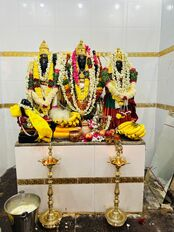
Sri Sai Prema Nilayam at Riverside near Los Angeles, California, USA, has shrines for both Shirdi Sai Baba and Puttaparthi Sathya Sai Baba. There is also a small sannidhi in it for our Sri Ram Durbar. A few Sai devotee volunteers attend the daily early morning suprabhatam services in Sai Prema Nilayam, and a small component of the Seva is a bouquet of stotra-shlokas specially offered in front of the deities of Sri Rama, Sita, Lakshmana and Hanuman, in their Sannidhi. This bouquet is part of a string of aaratis, which conclude the suprabhatam service. The stotra comprises the following shlokas.
> कौसल्यासुप्रजा राम पूर्वा सन्ध्या प्रवर्तते |
> उत्तिष्ठ नरशार्दूल कर्तव्यं दैवमाह्निकम् || 1 ||
>
> उत्तिष्ठोत्तिष्ठ गोविन्द उत्तिष्ठ गरुडध्वज |
> उत्तिष्ठ कमलाकान्त त्रैलोक्यं मङ्गळं कुरु || 2 ||
>
> मातः समस्तजगतां मधुकैटभारेः वक्षोविहारिणि मनोहरदिव्यमूर्ते |
> श्रीस्वामिनि श्रितजनप्रियदानशीले श्रीवेङ्कटेशदयिते तव सुप्रभातम् || 3 ||
>
> सौमित्रिणा च जानक्या चापबाणासिधारिणे |
> संसेव्याय सदा भक्त्या स्वामिने मम मङ्गळम् || 4 ||
>
> मनोजवं मारुततुल्यवेगं जितेन्द्रियं बुद्धिमतां वरिष्ठं
> वातात्मजं वानरयूथमुख्यं श्रीरामदूतं शिरसा नमामि || 5 ||
The first three shlokas by way of Suprabhatam greeting Perumal and Thayar have been taken from the Sri Venkatesa Suprabhatam recited daily at Tirumala temple. As the first shloka originally used by sage Vishvamitra addressing Sri Rama had been included in the Tirumala text from Valmiki Ramayanam, it is most appropriate as well for Sri Rama in any temple. The third addresses the greeting to Mother Lakshmi/Padmasani who is identified here with Mother Sita. The fourth shloka is from the mangala songs offered to Sri Rama after Ramayana recitations, and the fifth is one of the shlokas offering worship to Hanuman, recited before Ramayana parayana. The fourth is doing mangalaarati to Sri Rama, but its narrative refers to Ramaseva by Lakshmana as well as Sita, thus acknowledging their presence in the sannidhi. It is also interesting to find parents of all four divinities being remembered in shlokas 1, 4 and
- Sri Rama is addressed as Kausalyasupraja as also Sri Rama in shloka
- Lakshmana becomes Saumitri and Sita becomes Janaki in shloka
- Hanuman is seen as Vatatmaja (Son of Vayu) in shloka 5 which also tells us that he travels at the speed of the Windgod, Maruta or Vayu.
Is it only a coincidence that in the Sai Prema Nilayam, the devotees had started the suprabhatam service with only the first three shlokas taken from the Tirumala-Tirupati routine? After some time, one devotee seems to have added “Mano Javam--” to honor Hanuman, and promptly another devotee added "Saumitrina ca Janakya--" to honor Lakshmana and Sita, as if to re-emphasize Lord Rama's love of these three inseparable identities to form the four faces of Rama.

I thank the volunteer devotees for kindly providing information on the Suprabhatam seva.
Last year both Sri Rama Navami and the anniversary of Sai Prema Nilayam occurred together on April
- I was able to join in the festivities which included a glorious procession in the gardenway around the Temple. You can see that Sri Rama and his team are occupying conventional locations in the picture below. When the procession got under way, the murti of Hanuman was respectfully turned by 90 degrees thus facing the devotees just as Sri Rama, Lakshmana and Janaki were doing. The author of Hanuman Chalisa knew what he was saying, when at the end of each of the stanzas, he exclaimed, राम लक्ष्मण जानकी, जय बोलो हनुमान की!
I thank the volunteer-functionaries of Sai Prema Nilayam for allowing me to join the festivities, which included chanting of vedic sooktas, Vishnu sahasranama parayana and speeches by devotees.

Let us take time to offer silent prayers to the four avatara murtis who were here on earth long ago to save the world from the depredations caused by Ravana and his Rakshasa followers. Through their archa forms they continue to be available to us always. Two of them constitute param brahma tattva, the सर्वशेषी श्रीमन्नारायण, as Sri Rama and Sita. In perennial service to them are the शेषोत्तमs Lakshmana and Hanuman who have in recent times been reborn among us as Srimad Ramanuja and Srimad Madhva to reestablish Vishnubhakti and Vaishnava dharma in two different ways. Both the paths, while having some significant differences between them, agree with each other in identifying the param brahma tatttva as Narayana/Sriman Narayana. Apart from offering our worship to them in Sri Rama’s Sannidhi, let us learn to be true Vaishnavas/ SriVaishnavas, who can keep doing our duty and dedicating all of it to Sriman Narayana’s lotus feet.
The 13th sarga of Sundarakanda represents a turning point in Hanuman’s quest for Sita Piratti. He thought he had looked in all possible places in Lanka and was feeling desperate. He cursed his bad luck and wondered whether the search effort had been much delayed, and the worst fate had already befallen Devi. After a while he steadied himself and decided firmly that he would continue the search. As the first step, he offered prayers fervently, first to Sri Rama, Lakshmana and Sita and then to other divinities known to him.
> नमोsस्तु रामाय सलक्ष्मणाय देव्यै च तस्यै जनकात्मजायै |
> नमोsस्तु रुद्रेन्द्रयमानिलेभ्यो नमोsस्तु चन्द्राग्निमरुद्गणेभ्यः ||
His mind cleared and he was able to see Ashokavana close by, where he would soon be meeting the venerable object of his search. This divine messenger had almost arrived at the intended destination. The meeting of the minds of Sri Rama, Sita, Lakshmana and Hanuman that was taking place then would finally bring all of them to Ayodhya and the grand crowning ceremony.
Sri Rama’s face, which is one of the four Sundaramukhas considered in this article, occupies a central position in Sri Vishnu Sahasranama because Vishnu is referred to as Sumukha around the middle of the stotra-mahamantra, which features 1000 names of Vishnu. The face is good looking, charming, handsome. As Sri Rama’s face, it resembles a freshly blossomed flower. The long eyes in the face too are like lotus petals. This face did not change in its calm, peaceful poise, even when his crowning was rudely interrupted and he was asked to leave Ayodhya and proceed to the woods. Kamban sings of this phenomenon in these words.
> மெய்த்திருப்பதம் மேவு என்ற போதினும்
> இத்திருத்துறந்தேகு என்றபோதினும்
> சித்திரத்தின் அலர்ந்த செந்தாமரை
> ஒத்திருக்கும் முகத்தினை உன்னுவாள்.
Sita sitting by herself in Ravana’s Ashokavanam recalls Rama’s face which had the same appearance as a picture of a freshly blossomed lotus, whether he was listening to King Dasaratha offering him the royal throne or to Queen Kaikeyi demanding him to give up the throne and go to the forest.
Valmiki describes the unaffected state of Rama’s mind thus:
> न वनं गन्तुकामस्य त्यजतश्च वसुन्धराम् | सर्वलोकातिगस्येव लक्ष्यते चित्तविक्रिया || 2/19/33||
When Sri Rama had to discard the royal right to rule the world and had to accept banishment to the woods, his mind suffered no change whatsoever. Its state was the same as the mind of a great yogi who had renounced all worldliness. Goswami Tulsidas also sings about the unchanging face of Sri Rama similarly like this: प्रसन्नतां या न गताभिषेकतः तथा न मम्लौ वनवास दुःखतः | मुखाम्बुजश्री रघुनन्दनस्य मे सदास्तु सा मञ्जुलमङ्गलप्रदा ||
While Sri Rama’s countenance was unaffected by anything good or bad happening to him, Adikavi Valmiki has given beautiful word pictures of how the face registered appreciation, empathy or commiseration for others in appropriate contexts. Examples are many but we will look at just two of them.
Ayodhya Kanda, sarga 100: Bharata is simply unable to accept the kingdom which his mother had treacherously obtained for him. This act of hers had cost King Dasaratha his life. Bharata rushes with a full entourage to fall at the feet of his elder brother at Chitrakoota looking forlorn, miserable and unable to speak coherently. He had become emaciated and his face had lost colour. Sri Rama gathers him in his arms and looks at him lovingly as he starts questioning him gently.
Kishkinda Kanda Sarga 3: Hanuman meets Sri Rama and Lakshmana and speaks to them with respect and friendliness, while assuming the guise of a mendicant. His language and diction, choice of words and manner all impress Sri Rama immensely, and he praises him generously to Lakshmana.
Long ago, Brahma had vouchsafed the Ikshvaku clan two holy murtis to cherish and worship. He had been worshipping them himself up to that time. They were of his Creator Sriman Narayana, in the forms of Sri Rama and Sri Ranganatha. Later, Sage Vasishta was delighted when Narayana manifested as a son of King Dasaratha of the Ikshvaku race and named him after the Sri Rama image being worshipped in the royal household. The divine icon got the new name Moola Rama and Prince Rama would have become aware of the glory and stories of his namesake, no different from his own self, through the Shatakoti Ramayana, authored by Chaturmukha Brahma. Sri Rama, Lakshmana and Sita, Jambavan and Hanuman got the opportunity to do Pooja to the Moola Rama image according to the annals of the Raghavendraswami Matha. The ‘kuladhanam’ Ranganatha was presented by Sri Rama to Vibhishana after his own Pattabhishekam, but this archa divinity decided to stop in the middle of the south bound journey to occupy and bless an island on the laps of the Kaveri, according to the sthalapurana of Srirangam. The ancient Moola Rama murti, now with the Raghavendraswami Matha, must have blessed millions of devotees who visited him at Mantralaya and who had also worshipped Sita-Lakshmana- Hanumat sameta Sri Rama at home and in some temples. Narayana seems to have always loved Ayodhya. He arrived there in the royal household of the Ikshvakukula as a single deity that had the Sri Rama name and stayed there to witness his advent there as Dasaratha’s eldest son Sri Rama, whose parivar was carefully developed near Ayodhya and during the Ramayana yatra right up to Lanka. Over several centuries his archa form in the company of Mata Sita, Lakshmana and loyal Anjaneya has occupied the garbhagriha of many temples and pooja rooms of many houses as vigrahas and pictures to be worshipped with great love and admiration. He has now returned to Sri Ramajanmabhoomi to reign as Bala Rama to captivate the hearts of
devotees in his latest guise!

------ Moola Rama -------

----- Bhoopala Rama —---

------ Bala Rama ------
In the Budha Kaushika-inspired middle picture above, Sri Rama can be experienced as the complete Parama principle because Ma Sita is available with him. The two Seshottamas who understand this are also there with both as Lakshmana/ Ramanujacharya and Vayuputra Hanuman/Madhvacharya to bring joy and hope to many many jivas who receive the darshan of the infallible foursome, though centuries must have rolled by after the glorious meeting took place in Ayodhya!
> दक्षिणे लक्ष्मणो यस्य वामे तु जनकात्मजा ।
> पुरतो मारुतिर्यस्य तं वन्दे रघुनन्दनम् ॥
No reflections yet. Be the first to share your thoughts!