I happened to see this in U2 Brutus channel. At the outset, U2 Brutus is 'opposite' of vedabhasya channel. While vedabhasya channel tries to bring out the new dimensions from vedic scriptures by translating them originally, one of U2B aim is to showcase the obscenities from vedic scriptures, quoting originally from the very scriptures themselves. Hence I think U2B channel is doing a good service to the cause of vedas (though their aim is to debunk vedic literature and the so-called 'brahminism'). It helps us to focus on the original scriptures and refute their claims and understanding better.
It is absolutely true that in many 'interpretations' of different 'scholars', many of our scriptures have been interpreted 'obscenely'. Some of these translations are plain wrong because they were interpreted and not translated, in my understanding. Some of them could be deemed obscene from current social value systems viewpoint. But there are many such translations lurking all over causing a lot of confusion.
பெண்களை இழிவுபடுத்தும் பெரியவா | வேதங்களில் உள்ள ஆபாசங்கள் | Prakash | U2 Brutus - YouTube
Coming to the video, what prakash quoted is from Apastambha Grhya sutras. Grhya sutras are procedures for carrying household duties. Now we follow an abridged or diverged version of sutras based on different social value systems now. So grhya sutras are not vedic scriptures at all. Yet, I thought it may be worth to look at the sutra to understand what it said. In chapter 8 section 20+ , the grhya sutras are talking about how to do pitr kAryam. It's detailing the srardham procedures. Finally there is a sloka on how 'jIva' is subjected to distress. This sloka has been wrongly interpreted by many for generations and this interpretation has been carried through.
Let's look at what the sloka said. The following is the 'text', as well as rightly shown in the screen. (prakash pronounced it differently. One can check my text here, what was shown on screen and how prakash pronounced them and figure out which is right or wrong).
asamza (without doubt) vepsuh (vibrating) pareSAm (the supreme one) sthulA (the gross/phyical) dArikA (female child) jIva (life/living being) cUrnAni kAraM thitva(by the powdery property), uttarayA (to reply, to defend oneself), supthAyAr (sleeping one) sambAdha (distress) upavapet (fills up/chokes)
The background is this. puruSa and Stri/Prakrti are in the ardha-nareeswara form. puruSa is the observer or sAksi that does not undergo change. Stri is the one that evolves, undergoes changes and evolves (say shakti or the worman), produces the next generations. Colloquially, puruSa is the paramAtma. jivAtma evolves on the stri.
At the end of all srardha offerings, Apastambha sutra says,
Without doubt (asamza) vibrating Supreme one (vepSuh pareSam), who is sleeping, (that's the nature of puruSa) fills up with distress (sambAdha upavapet), the gross femalish jIva (the living forms are the gross femalish ones, sthula dhArika jIva) by their powdery property (churnAni kAraM thitva).
We, the jiva, the matter forms and beings undergo torment and distress in this Universe, while the Supreme one is sleeping or remains an observer or sAksi to our sufferings. It happens because jIva has the property of being sthula (physical or gross) and can be disintegrated /powdered (churnAni kAram), unlike the Supreme one which is indivisible.
Basically at the end of srArdha offerings, this is the 'realization' of 'sambAdha or distress' that jIva undergoes.
But the commentary around this sutra shifts to a man who does not want his 'wife' to be with another man and talks about some procedures for it based on the above sutra. I am not sure how all of a sudden the context shifted to a man wanting his wife not to see another man.. That's not related to pitr kAryam. But this is the interpretation provided in the commentaries (as far as I understand) of 'sudarshanacharya', though the sutra talks something else.
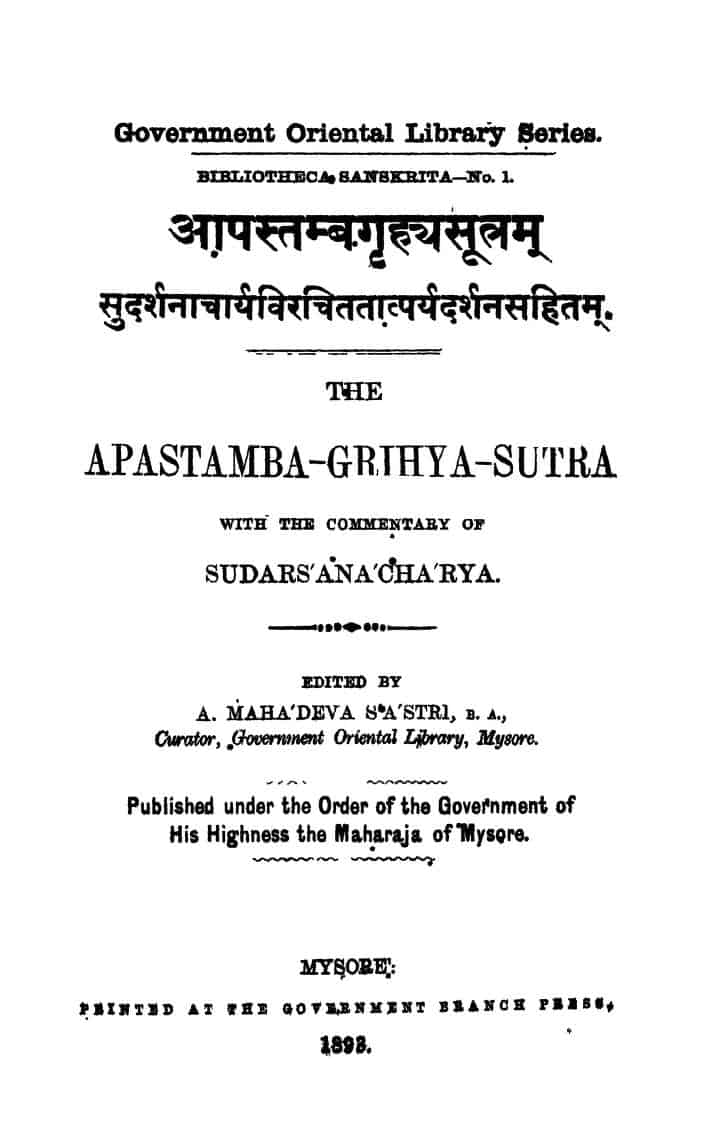
So this sort of understanding is not originating from Prakash or U2B channel or even mahAdeva sastri who compiled and published the sanskrit version or from Hermann olderberg who published the english translation. I have no idea why such a commentary is made around such a sutra by sudarshanacharya.
It just points to the fact that we have to really 'read' and translate our scriptures originally not relying on commentaries of other acharyas alone.
References
https://www.wisdomlib.org/hinduism/book/apastamba-grihya-sutra/d/doc116812.html
https://ia600909.us.archive.org/2/items/in.ernet.dli.2015.513503/2015.513503.The-Apastamba-Grihya-Sutra.pdf
No reflections yet. Be the first to share your thoughts!