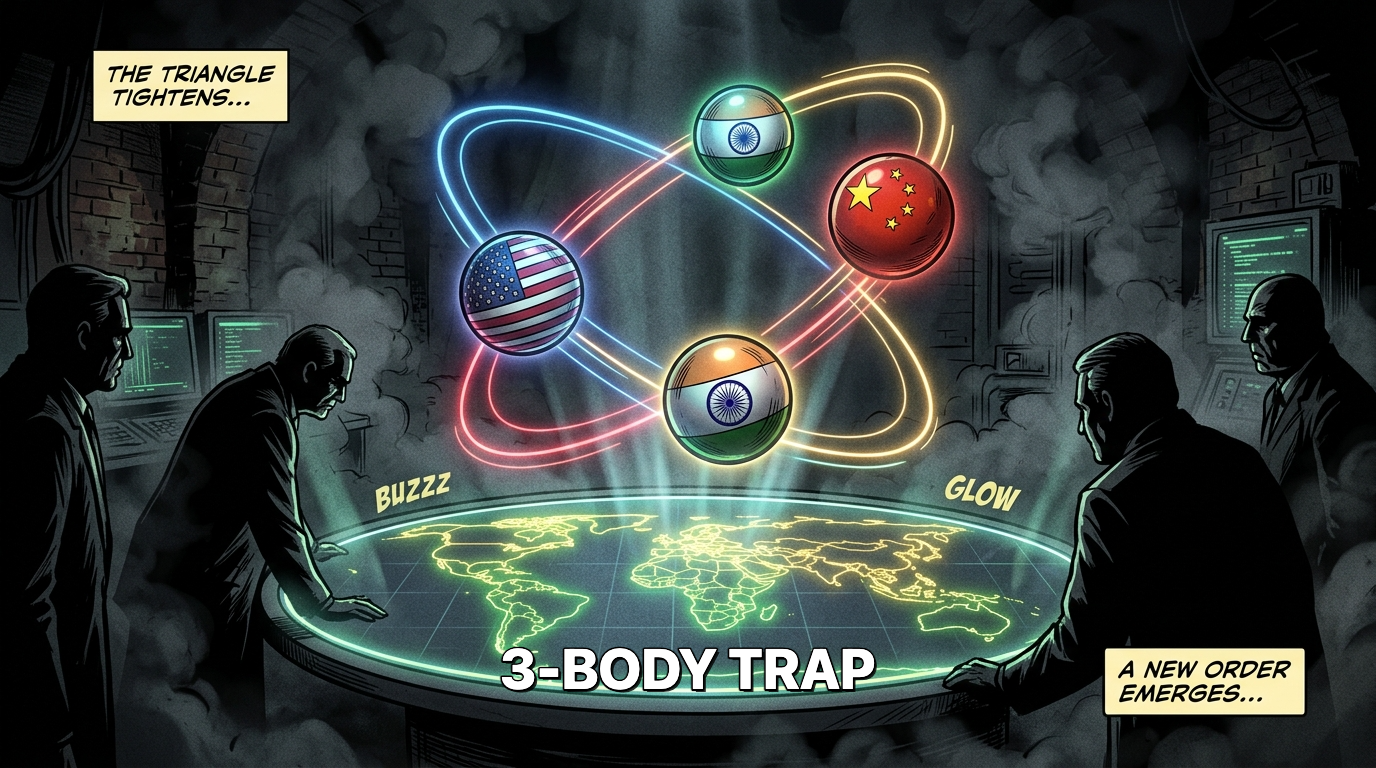
The fiction of a predictable, rules-based multilateral world order came to a formal end at the World Economic Forum in Davos earlier this year. Amid sweeping protectionist mandates, fragmented security frameworks, and a historic retreat from post-WWII globalism, the strategic community was handed a stark post-mortem. It is no longer a "transition" to a new global software; it is a fundamental, structural rupture.
Nowhere is this rupture more visible than in the high-stakes, transactional geometry forming between Washington and New Delhi. For years, Western political commentators loosely utilized the term "multipolarity" to describe the rise of developing economies. However, that framework obscures the actual consolidation of global power. The world is not shattering into dozens of decentralized fragments. Instead, it is settling into a highly volatile, tripolar architecture anchored by the United States, China, and India.
A Brief Primer: What is Game Theory?
Before decoding this new tripolar friction, it helps to understand the mathematical lens through which it is analyzed. Game Theory is the study of strategic decision-making. It applies when a player's outcome depends not just on their own choices but also on the choices of every other player in the system.
Instead of looking at international relations through the lens of emotion, ideology, or morality, game theory strips statecraft down to cold, mathematical variables:
Players & Payoffs: The actors involved (nations) and the rewards they seek to maximize (wealth, security, resources, or sovereign power).
Dominant Strategy: A course of action that yields the highest payoff for a player, regardless of what their opponent chooses to do.
Nash Equilibrium: A state of play where no player has an incentive to unilaterally change their strategy, because doing so would instantly worsen their own payoff.
Iterated Games: Unlike a "one-off" interaction where a player can cheat or exploit a partner without consequence, international relations is an iterated game—a continuous, multi-round loop where past actions establish reputation and dictate the payoffs of future rounds.
When applied to modern geopolitics, these concepts transform complex global headlines into a highly logical chess match.
The Co-opetitive Matrix: Landau’s Candor
The underlying tension of the U.S.-India relationship burst into raw visibility at the Raisina Dialogue in New Delhi. Christopher Landau, a senior envoy representing the "America First" administration, delivered an unvarnished moment of geopolitical clarity. While discussing a pending bilateral trade agreement, Landau explicitly warned that Washington would not repeat what it considers the past strategic errors made with Beijing.
"India should understand that we're not going to make the same mistakes with India that we made with China 20 years ago," Landau told the audience, explicitly referencing the unchecked market access that allowed China to evolve into a formidable commercial competitor. "Then the next thing we know, you are beating us in a lot of commercial things. We are going to make sure that whatever we do, it's fair to our people."
Stripped of standard diplomatic fluff regarding "shared democratic values," Landau’s statement laid bare a classic Asymmetric Co-opetitive Game:
The Shared Payoff (Cooperation): Both players face a severe external variable—China’s military and geographic assertiveness in the Indo-Pacific. To optimize their defense payoffs, Washington and New Delhi must cooperate through platforms such as the Quad or recent maritime domain awareness initiatives.
The Zero-Sum Payoff (Competition): Economically, the U.S. views trade through a strictly mercantilist lens. If India achieves absolute technological and economic sovereignty—exporting its own open-source financial rails or dominating manufacturing—the U.S. experiences a relative decline in its global monopoly power.
The U.S. dominant strategy is clear: keep India robust enough to act as a regional military buffer against Beijing, but economically bound enough that it can never shatter the glass ceiling of Western hegemony.
The Backyard Sub-Game: Hawk-Dove in South Asia
To enforce this economic asymmetry, Washington has pivoted to an aggressive Hawk-Dove game in India’s immediate periphery. The sudden, systemic shifts across South Asia—including the Trump administration's use of Pakistan as an interim mediator in Middle Eastern ceasefire talks, and Washington's rapid execution of a reciprocal trade agreement with Bangladesh following the rise of Dhaka’s new BNP-led coalition—are not random diplomatic maneuvers.
In game-theoretic terms, these moves are designed to inject calculated volatility into India's neighborhood. By cultivating direct, transactional relationships with Islamabad, Dhaka, and Kathmandu, the U.S. forces India into a defensive, regional posture. If New Delhi is perpetually tied down managing border brushfires and balancing political realignments in its immediate backyard, it has less diplomatic bandwidth, intelligence assets, and capital to project full sovereign power into Europe, Africa, or the global financial system.
The Domestic Leverage Point: Opposition Amplification
In a complex, multi-round game, an external power does not merely interact with a nation's ruling executive; it leverages that nation's internal political contradictions to restrict its strategic moves. In India's case, the domestic opposition's critiques—led by figures like Rahul Gandhi and the Congress party—frequently function as inadvertent pressure valves that aid the external player's containment calculus.
During the explosive parliamentary budget debates in early 2026, the Leader of the Opposition aggressively thrashed the government over what he described as a "wholesale surrender" to Washington under the interim trade framework. By publicly highlighting the unequal tariff structure—where Indian goods face an 18% U.S. levy while New Delhi dropped certain digital and agricultural tariffs to zero—the opposition effectively weaponizes the transactional cost of the game.
When domestic political rivals accuse the prime minister of compromising energy sovereignty or abandoning local sectors under external coercion, they dramatically raise the ruling executive's internal political cost of negotiating complex, high-stakes trade pacts. This internal democratic friction ties the government’s hands, forcing New Delhi to spend vital domestic capital defending its executive decisions rather than executing its global strategy fluidly.
The Indigenous Counter-Strategy: Defense, DPI, and the Final Frontier
India, however, is not playing a static game. As an iterated arena, repeated interactions allow a player to alter the rules of the board over time. New Delhi's counter-strategy relies on three powerful mechanisms designed to erase foreign leverage entirely:
- Breaking the Defense "Kill Switch"
Historically, India’s strategic autonomy was vulnerable to supplier blackmail; a nation dependent on foreign capital for military hardware can always be coerced by the threat of frozen spare parts. Through its "Make in India" defense push (Aatmanirbhar Bharat), New Delhi has systematically upended this. In the 2025–26 fiscal cycle, India's domestic defense production hit an all-time record of ₹1.78 lakh crore, while defense exports skyrocketed to ₹38,424 crore. By mass-producing its own indigenous fighter jets, advanced artillery, and combat helicopters, India is removing the physical "kill switch" Western or Eurasian powers hold over its sovereign choices.
- Exporting Alternative Financial Rails
While the U.S. utilizes flat tariffs and legal boundaries to defend its 20th-century economic model, India is writing the open-source code for 21st-century global commerce. By exporting the India Stack and the Unified Payments Interface (UPI) as digital public goods to dozens of nations across the Global South, New Delhi is driving an interoperable network-effect breakout. Once real-time, account-to-account cross-border linkages reach a critical mass of global users, they create a decentralized financial web that bypasses Western proprietary networks, transaction fees, and the threat of unilateral executive sanctions.
- The Asymmetric High Ground: ISRO’s Science Diplomacy
The final piece of India's breakout strategy takes place outside the atmosphere. For decades, access to space was an exclusive, high-cost country club dominated by Western agencies and heavily policed by export control cartels like the Missile Technology Control Regime (MTCR). The Indian Space Research Organization (ISRO) has completely weaponized "frugal innovation" to break this monopoly.
By operating a highly resilient, low-cost launch ecosystem (with vehicles like the LVM3 and PSLV delivering cost-to-payload ratios that actively compete with heavily subsidized Western private launch providers), ISRO has turned space into a potent tool of soft power. Hosting the BRICS Heads of Space Agencies meeting in Bengaluru earlier this summer, India consolidated a parallel framework for shared satellite imagery, climate monitoring, and disaster management data across eleven member nations. By training technicians from dozens of emerging nations via its UNNATI nanosatellite capacity-building program, New Delhi is providing the Global South with independent geospatial intelligence and technological sovereignty—ensuring that developing nations no longer have to barter away their autonomy to Western commercial satellite constellations or intelligence agencies for basic environmental and national security data.
Why the Commentariat Stumbles: The Western Blind Spot
Despite the mathematical clarity of this consolidation, the "India angle" remains largely invisible or distorted among mainstream Western commentators. This analytical deficit stems from a structural blind spot. Western media and think-tank networks remain deeply addicted to an anachronistic, bipolar hangover—insisting on framing the 21st century exclusively through a "Washington vs. Beijing" or "Democracy vs. Autocracy" lens. When India practices multi-alignment (buying Russian oil while expanding the Quad, or signing comprehensive trade deals with the EU to hedge against U.S. protectionism), it violates the binary models of Western political theory.
Furthermore, Wall Street and Silicon Valley commentators operate under the insular assumption that global modernization must mirror the American corporate architecture of proprietary, fee-extracting monopolies. They look at UPI and see a localized digital payment tool for street vendors, fundamentally missing the fact that an open-source, public account-to-account infrastructure can systematically outscale and disrupt traditional Western rails. Similarly, Western aerospace analysts view ISRO merely as a civilian research agency with a budget, ignoring the fact that its open-architecture data-sharing is a calculated geopolitical move designed to dissolve the West’s chokehold on orbital intelligence. By hyper-focusing on domestic cultural friction rather than tracking macroeconomic, space-tech, and defense infrastructure milestones, the Western commentariat continues to use a 20th-century map to navigate a 21st-century tripolar board.
The Tense Equilibrium
The introduction of the China angle ensures that this tripolar grid cannot easily fracture into an outright cold war. The U.S. cannot afford to completely alienate its primary Indo-Pacific shield; India cannot completely sever its Western intelligence and technology pipelines while its border with Beijing remains sensitive.
Consequently, the world is grinding toward an uneasy, transactional equilibrium. Traditional European allies, stung by Washington’s protectionist mandates, are already realigning their geometry—as proven by the historic EU-India Free Trade Agreement signed to bypass U.S. consumer markets.
The lesson of the current decade is one of demographic and technical arithmetic. While Western populism attempts to mount a rearguard action to stall the decline of its economic monopoly, the center of global gravity continues its steady slide East and South. The U.S. remains an undeniable military superpower, but as India continues to weaponize open-source digital public infrastructure, orbital diplomacy, domestic defense indigenization, and its own intense internal political consensus, it is successfully proving that a sovereign nation can step completely through the glass ceiling—and force the West to negotiate with a peer it can no longer contain.
No reflections yet. Be the first to share your thoughts!